

Is It Okay For Gays To Wear Makeup Catholic Answers
How the Cosmic Priesthood Became an Unlikely Oasis for Many Gay Men
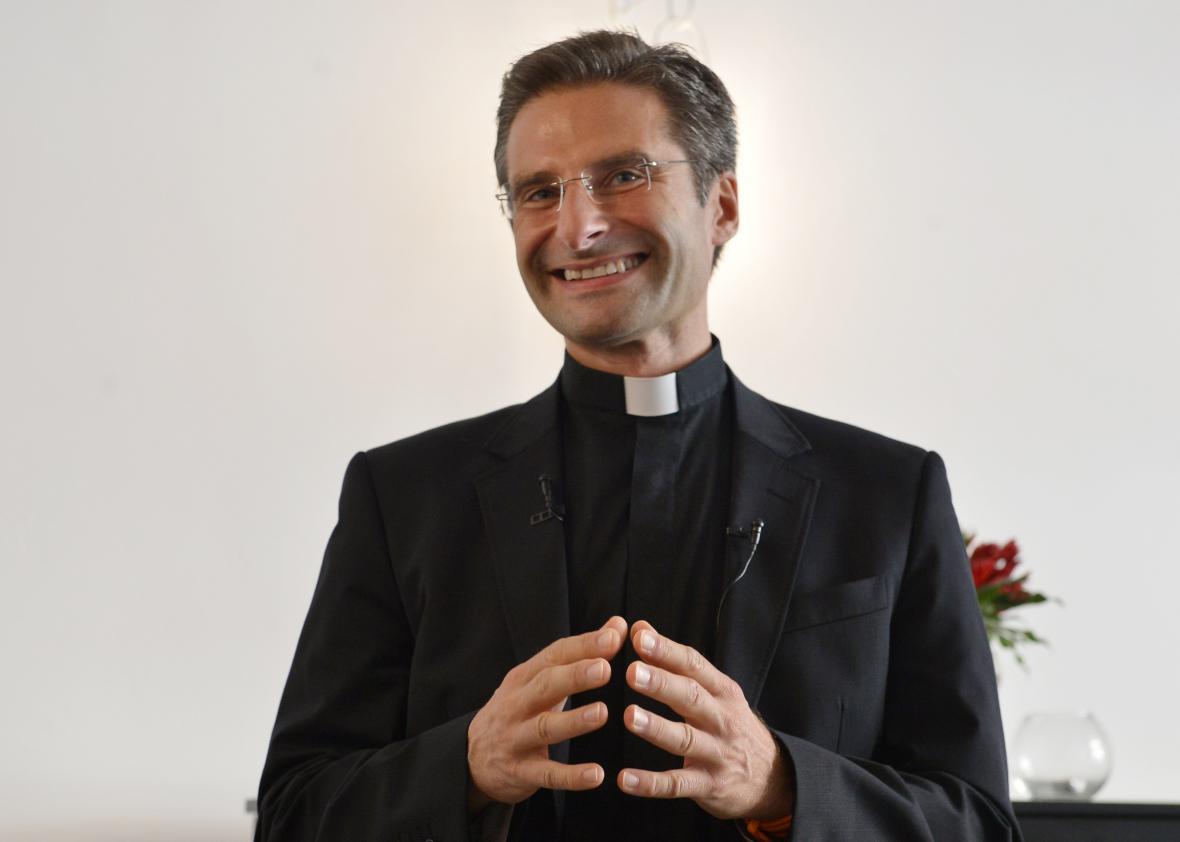
Tiziana Fabi/AFP/Getty Images
Adjusted from The Sex Effect: Baring Our Complicated Relationship With Sex, out now from Sourcebooks.
Back in March, Pope Francis sparked a moving ridge of headlines when he hinted at the possibility of ordaining married men equally priests. Since there'due south no evidence that church practice will actually alter, reactions to Francis' comments were premature. Merely the speculators ignored ane interesting bespeak: Opening the priesthood to married men would probably reduce the high per centum of priests who are gay.
While doing research for my volume The Sexual practice Outcome , I came across many scholars who suggested that preventing priests from marrying altered the makeup of the priesthood over time, unintentionally providing a shelter for some devout gay men to hide their sexual orientation. By standing to disqualify women and married men, the priesthood attracts men who desire to forgo sex activity for the residuum of their lives in an endeavor to go closer to God. Because the church denounces all gay sex, some devout gay men pursue the celibate priesthood as a self-incentive to avoid sex with men, which tin help them circumvent perceived damnation.
Of course, many factors influence a person'southward decision to join the clergy; it's non like sexuality lonely determines vocations. But it'southward dishonest to dismiss sexuality's influence given that we know there is a asymmetric number of gay priests, despite the church'due south hostility toward LGBTQ identity. Every bit a gay priest told Frontline in a Feb 2014 episode, "I cannot sympathize this schizophrenic attitude of the hierarchy confronting gays when a lot of priests are gay."

Sourcebooks
So how many gay priests actually exist? While there's a glut of homoerotic writings from priests going back to the Middle Ages, obtaining an authentic count is tough. Only most surveys (which, due to the sensitivity of the subject, admiittedly suffer from limited samples and other design issues) find between 15 pct and l percent of U.S. priests are gay, which is much greater than the 3.8 percentage of people who identify as LGBTQ in the general population.
In the last one-half century there's likewise been an increased "gaying of the priesthood" in the Due west. Throughout the 1970s, several hundred men left the priesthood each year, many of them for marriage. As straight priests left the church for domestic elation, the proportion of remaining priests who were gay grew. In a survey of several m priests in the U.S., the Los Angeles Times plant that 28 percent of priests betwixt the ages of 46 and 55 reported that they were gay. This statistic was college than the percentages found in other age brackets and reflected the outflow of directly priests throughout the 1970s and '80s.
The high number of gay priests as well became evident in the 1980s, when the priesthood was hit difficult by the AIDS crisis that was afflicting the gay community. The Kansas City Star estimated that at least 300 U.S. priests suffered AIDS-related deaths betwixt the mid-1980s and 1999. The Star concluded that priests were about twice every bit likely equally other adult men to die from AIDS.
Given that the church building has called a gay orientation an "objective disorder" and gay sex activity "an intrinsic moral evil," it may seem bewildering why a gay man would chose this profession. But information technology makes more than sense after realizing the church encourages sublimation of homosexuality through prayer. "Homosexual persons are called to chastity," states the Catechism of the Catholic Church. "By the virtues of self-mastery that teach them inner liberty, at times by the back up of disinterested friendship, by prayer and sacramental grace, they tin can and should gradually and resolutely approach Christian perfection."
Sexual sublimation is by far the almost common theory in the literature every bit to why there are then many gay priests. At that place has likewise been speculation that as a discriminated-against minority group, gay men may be more than sensitive to empathize with people—a stiff desire to assist others leads some of these men to the donating priesthood. Some other common theme is that clerical celibacy is good cover for gay people wanting to hide their orientation.
The U.S. Conference of Cosmic Bishops' National Review Board reported that "certain homosexual men appear to have been attracted to the priesthood because they mistakenly viewed the requirement of celibacy every bit a means of avoiding struggles with their sexual identities." As gay former-priest Christopher Schiavone put information technology, "I thought I would never need to tell another person my hole-and-corner, because celibacy would make information technology irrelevant."
Information technology's not as if the church is unaware of this upshot. A past president of the USCCB complained virtually an "ongoing struggle to make sure that the Catholic priesthood is not dominated by homosexual men." And Pope Benedict once said that homosexuality in the priesthood was "one of the miseries of the church" and that the church building needed to "caput off a situation where the celibacy of priests would practically end upwardly being identified with the tendency to homosexuality."
Assuasive more than married men in the priesthood would probably bring more than direct men into the fold, which would reduce the percentage of priests who are gay. Given that the worldwide number of permanent deacons (who tin can be married and can perform most every task required of a priest except consecrate the Eucharist or hear confessions) has increased by nearly twoscore,000 people in the past forty years, at that place appears to exist a large group of married men open up to clerical life.*
But just because some church officials would like to encounter fewer gay priests doesn't mean that a alter in discipline would benefit the institution. A large percentage of priests being gay doesn't automatically equate to a crisis or indicate that church building education should alter. Though other denominations have shown that women, married men, and sexually-agile LGBTQ people can be entirely competent equally pastors, for centuries the Catholic Church'southward model of relying on single, sexually-abstinent men has generally served the institution well. And nigh Catholic priests are psychologically well-adjusted and satisfied with their lives and occupation.
Rather, the gaying of the priesthood denotes a complex miracle that makes many people uncomfortable, an example of sexual regulations producing unintended consequences. For the virtually function, the church continues to downplay shifting cultural contexts in favor of adhering to sexual renunciation laws adult by ancient eschatological communities and desert ascetics responding to an uncertain earth. The church besides continues to rely on clerical structures that were influenced past social and economic weather condition from the Middle Ages.
In doing so, the hierarchy has contributed to a miracle information technology would rather accept people ignore: Rigid policies on homosexuality and clerical celibacy have inadvertently driven many gay men toward the priesthood. "Bishops are defenseless in the eye and running scared," priest-theologian Richard McBrien told reporter Jason Drupe in his book Lead Us Not Into Temptation. "They live in a church with a very hardline policy on homosexuals, all the same they realize they're cartoon from that population well beyond its presence in lodge, by default."
A paradox of this magnitude seems baffling. And it certainly is baffling for the gay priests who battle cerebral dissonance. Simply equally an entry in Human Sexuality in the Catholic Tradition points out, "Christian faith proclaims its deepest truth in paradoxes." The contemporary church building's greatest paradox may be that its positions of potency continue to be heavily represented past people information technology declares "objectively disordered."
*Correction, Apr 20, 2017: This post originally mischaracterized the Church'due south policy around permanent deacons and union. A married man tin can go a deacon, but he may non marry after becoming one without special permission.

Is It Okay For Gays To Wear Makeup Catholic Answers,
Source: https://slate.com/human-interest/2017/04/how-the-catholic-priesthood-became-a-haven-for-many-gay-men.html
Posted by: furrwassaimmat.blogspot.com
0 Response to "Is It Okay For Gays To Wear Makeup Catholic Answers"
Post a Comment