

What Is The Moon Makeup Characteristics
Mike Sutton looks at what we've learned about the moon's chemistry in the 50 years since Apollo xi
On 20 July 1969, Apollo 11'due south lunar module landed on the surface of the moon. A few hours subsequently, on 21 July, Neil Armstrong and Buzz Aldrin stepped out. The mission was the culmination of the decade long Apollo plan to take humans to the moon. Information technology was undoubtedly one of the crowning scientific and engineering achievements of the 20th century – but what did nosotros larn about the moon?
During Armstrong and Aldrin'due south two and a quarter hours spent outside the module on the moon, they collected around 20kg of rocks and other lunar textile. The subsequent v Apollo missions that reached the moon besides brought back samples, over 300kg in total.
When the Apollo astronauts returned with their treasures, chemists could brainstorm investigating our satellite'due south composition directly. This research even so continues, every bit new analytical techniques are developed and fresh theoretical questions posed.
All at sea
When Galileo Galilei published his revolutionary telescopic observations in 1610, he attributed the changing patterns of light he saw on the moon'due south surface to mountains catching the lunar dawn before it reached the lowlands. This decision was immediately challenged by academic philosophers, who regarded it equally incompatible with Aristotle'due south doctrine that all angelic bodies were perfect spheres.
Spectroscopy could detect elements in the sun, but it revealed piddling well-nigh the moon, which merely reflects solar light
Past the late 17th century, yet, it was widely accustomed that the moon was a material body with topographical features resembling the Earth'southward. Its darker and smoother areas were therefore chosen maria (seas), and its brighter and rougher regions terrae (lands). Its numerous craters were causeless to be volcanoes. In his 1687 Principia Mathematica Isaac Newton estimated the moon'south gravitational pull from measurements of the rise and fall of tides, and calculated its density to be eleven-ninths of the Earth's – about double the correct value.
Although 19th century physicists could measure the moon'southward mass far more accurately, its composition remained mysterious. Spectroscopy could detect elements in the sun and stars, but initially it revealed little nearly the moon, which just reflects solar light, minus the frequencies it absorbs.
In the 20th century, bigger telescopes and better photography produced more detailed maps of the moon's surface. However, the relative importance of volcanism and battery in shaping that surface was vigorously disputed – notably in heated exchanges between Nobel prize-winning American chemist Harold Urey and distinguished Dutch–American astronomer Gerard Kuiper. Meanwhile US astronomer Ralph Baldwin's calculations – indicating that most lunar craters were likewise large to be volcanic – were largely ignored until the infinite race started.
First landings
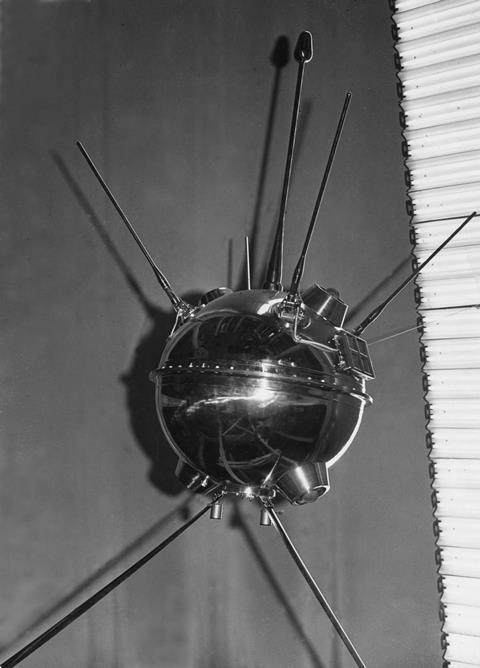
In 1959 the USSR'southward Luna 2 probe striking the moon. Before the impact its instruments detected no magnetic field, implying the absence of an Earth-like core of liquid iron. Seismological observations later indicated that the moon'southward iron core is very small, and mostly solid. When Luna 10 orbited the moon in 1966, its gamma-ray spectrometer analysed the radiation emitted from atomic nuclei that had been struck by high-energy cosmic rays. It detected elements indicating the presence of basalt – the most common terrestrial volcanic rock – in the darker regions notwithstanding called maria. Astronomers had long agone concluded that these 'seas' contained no water, simply the proper noun survived.
In 1967 the U.s.'due south Surveyor 5 landed on Mare Tranquilitatis – the 'Sea of Placidity'. It used alpha-particle back-scattering from elements on the surface to place a specific type of basalt, commonly found in Greenland (basalt is not a single compound, but a mixture of different silicates in variable proportions). The adjacent step was for astronauts to collect lunar samples.
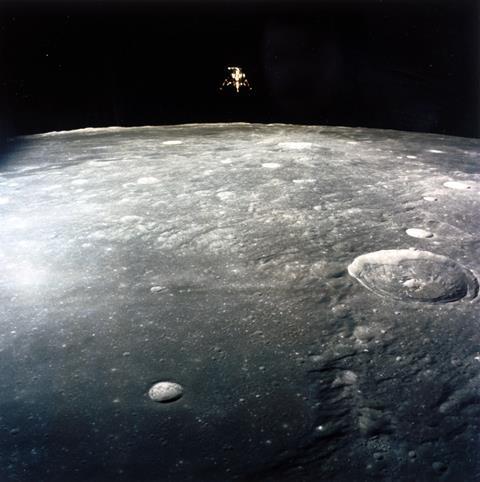
Between 1969 and 1972 the United states of america's six Apollo landings yielded approximately 381kg of material, while three of the USSR'due south robotic probes returned 0.326kg betwixt 1970 and 1976. Scientists examined these specimens intensively, as information technology seemed unlikely that more would get bachelor for many years. In 1982, however, some other source was identified by New Zealand geochemist Brian Mason, the curator of meteorites at the Smithsonian Found in Washington DC.
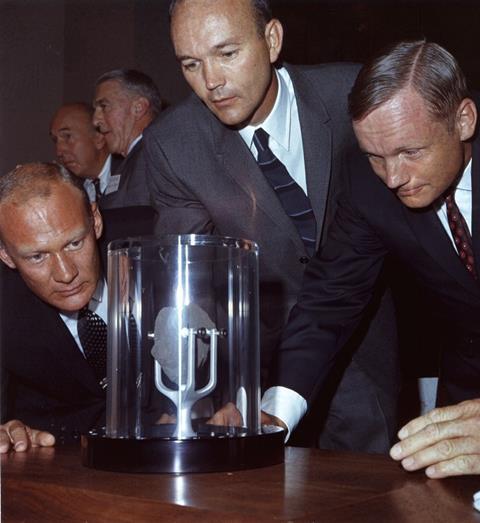
When Nasa sent him an unusual specimen from Antarctica, Mason chop-chop recognised its resemblance to fabric nerveless by astronauts. Its distinctive fe–manganese ratio later on confirmed that information technology came from the moon – blasted gratis by some gigantic impact, and subsequently captured by the Earth'southward gravity. More meteorites – over 190kg in total – have since yielded chemical and mineralogical bear witness of their lunar origin. These bodies also comprise radioisotopes generated past exposure to cosmic rays on the moon or in space. Inside Globe's atmosphere, which muffles cosmic radiation, the formation of these 'cosmogenic nuclides' ceases, and equally they accept different decay rates their relative proportions indicate when a meteorite reached Earth.
Not cheese later on all
Interpreting all this data is a problematic exercise, considering the lunar surface is a composite entity. Unlike the Earth, the moon has no magnetosphere to prevent the solar wind depositing hydrogen (and lesser amounts of heavier elements) on it, and while the depression lunar gravity allows much of this fabric to dissipate into space, more keeps arriving. The moon is also littered with meteors that differ significantly from its original surface fabric – which has itself been radically transformed by violent impacts.
Much of the lunar surface is covered with regolith, a powdery mixture of rocks that have been smashed and and so repeatedly stirred by battery – a process selenologists call 'gardening'. Information technology often contains tiny glassy spherules, well-nigh of them probably created when meteoric impacts melted silicate rocks and scattered the resulting droplets, though some may be of volcanic origin. Bigger impacts released plenty energy to fuse heterogenous mineral deposits into composite rocks – known as breccia – which subsequent bombardments shattered. Gradually, this cluttered tape has been deciphered.
Before the infinite age began, nosotros knew the moon's density was about 60% that of the Earth'southward. Data from orbiting instruments and surface samples confirmed the predominance of lighter elements in its crust. Main among these are oxygen (45% by weight) and silicon (21% by weight), by and large combined with aluminium, calcium, magnesium, iron and titanium in various silicate minerals. Many other elements occur in smaller amounts, though the heavier ones are very rare.
The spatial distribution of these elements is uneven. On average, lunar highland rocks incorporate nearly three times as much aluminium, virtually one third every bit much atomic number 26, and less than 1 fifth as much titanium every bit maria basalts. But these figures still under-stand for the moon's multifariousness. Samples from unlike landing sites show meaning variations, every bit do the lunar meteorites plant on Globe.
Apollo xi, 12 and 14 all targeted lowland areas. Their samples differed noticeably from each other, and more than markedly from material gathered on highland sites past Apollo xv and 16. Analogous differences were institute betwixt lowland samples returned from Luna sixteen and 24 and highland material provided by Luna 20. From the unusual terrain of Mare Serenitatis Apollo 17 brought unique finds which further enriched the picture. Afterwards, a broader context for all these results emerged from lengthy spectroscopic surveys made past orbiting probes, including the US'southward Lunar Prospector (1998–9) and the European Space Agency's SMART-1 (2003–6).
Nether a floating crust of lighter substances, denser materials similar the iron-rich olivine sank into the even so-molten magma beneath
Overall, the commonest lunar highland stone is anorthosite (which is also widespread on Globe). Lunar anorthosites consist mostly of plagioclase feldspar, a mixture whose main component is anorthite (CaAliiSi2Oviii), plus some albite (NaAlSi3Oviii). Highland rocks may as well include smaller quantities of other minerals – including olivine (a mixture of MgtwoSiO4 and Atomic number 26twoSiOfour) and ilmenite (mainly FeTiOiii), both of which are more plentiful in the maria.
Astronauts exploring the maria on human foot constitute rock fragments lighter in colour than the surrounding cloth, and chemically unlike from it. They proved to exist debris from highland feldspar rocks, shattered and scattered by massive meteoric impacts. Trapped argon bubbles in these specimens (produced past radioactivity of potassium-40) revealed that they had solidified much before than the maria basalt beneath them.
Isotopic dating of its oldest rocks indicates that the lunar surface began solidifying well-nigh 4.5 billion years ago. Under a floating crust of lighter substances (mainly anorthosites), denser materials like the iron-rich olivine sank into the still-molten magma beneath. Meanwhile, collisions with asteroid-sized bodies made huge depressions in the surface, some of which became filled with molten rock to create the maria. This procedure, nevertheless, was more complex than it first seemed.
The relative ages of maria can exist estimated from the extent to which their (originally shine) surfaces take been cratered by subsequent impacts, but isotopic dating of samples tin can show more than precisely when whatsoever particular surface solidified. It appears that most of the basins created past asteroid impacts were not filled with magma immediately – indeed, the filibuster could last many millions of years. This upwelling therefore required another contributory factor, which further chemical investigations revealed.
Kreeping towards agreement
Many Apollo samples included an unexpected component – a mixture known equally 'Kreep', containing potassium (K), rare earth elements (REE) and phosphorus (P). Due to various physical and chemical constraints, these elements were reluctant to crystallise with the substances surrounding them, and and then became concentrated in the remaining liquid magma. When they did eventually solidify, they were often accompanied by other relatively unsociable elements. These included uranium and thorium which – along with the radioactive potassium-40 – could generate plenty heat to melt rocks.
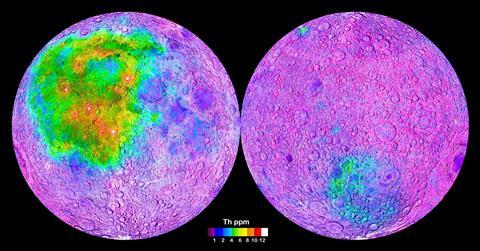
It seems probable that sub-surface concentrations of these oestrus-producing elements powered the volcanic activity which penetrated the lunar crust and filled the affect depressions. This thesis is corroborated by a surprising bibelot. The side of the moon facing away from the Globe has many touch basins, but hardly any maria. This is attributed to resistance from the far side's crust, which satellite surveys have shown to be well-nigh 15km thicker than the chaff on the side facing us. Also significant is the relative scarcity – equally revealed by satellite observations – of oestrus-generating Kreep deposits on the far side.
As testify about the moon'south composition accumulated, debate about its origins intensified. Some astronomers had suggested that the moon was spun off from the proto-Earth – just computer modelling shows this would require an improbably high rotational velocity. Others thought the moon coalesced from a cloud of dust orbiting the World – though how this cloud originated remained mysterious. And some assumed that the Earth captured a fully-formed moon which crossed its path during the solar system'south chaotic youth. Figurer models, all the same, bespeak that unless the trajectories of two such bodies were optimally aligned, either a miss or a collision would take resulted.
At present, the most persuasive origin theory is that collision with a Mars-sized torso remodelled the World, and created the moon. Strong evidence for this comes from the remarkable similarities found between lunar and terrestrial chemical science. Although the moon is poorer in heavier elements, the relative proportions of its lighter elements are very like to those on Earth. Moreover, the isotopes of certain elements (notably oxygen) occur in about-identical proportions in terrestrial and lunar rocks. In contrast, other actress-terrestrial samples – from meteorites, and from the Mars probes – exhibit much greater chemic and isotopic variety.
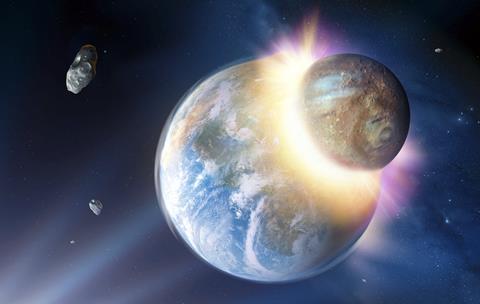
It therefore seems likely that about 4.six billion years agone a stray planet (retrospectively named Theia) collided with the Earth then violently that about all of its matter – and much of the Earth's – vaporised. This incandescent gas became thoroughly mixed earlier well-nigh of it re-solidified around the Earth's core, while the balance condensed to form the moon.
Applying new techniques to existing resources can still tell u.s. more than near the Moon's composition and history – this yr, the Apollo Adjacent Generation Sample Analysis program committed $8 1000000 (£6.three million) to fresh projects – merely a new surge of exploration has already begun. Red china'south Chang'east 4 lunar probe is at present transmitting exciting data from the Aitken Basin, near the moon'due south southward pole. This huge depression – 134km wide and 6km deep – was probably created past a 200km wide asteroid effectually four billion years ago. Scientists take long believed that information technology cracked the lunar crust, releasing molten material from the mantle (though non enough of it to form very large night areas like the maria on the moon'due south near side).
Spectrochemical analyses past Chang'e 4 have now identified surface minerals which support this exclamation, and more results are expected shortly. Meanwhile Nasa is urgently seeking Federal funding for human landings by 2024, and entrepreneurs are preparing privately funded missions to search for exploitable mineral resources. Much has already been learned most the moon's chemical science, only further surprises may still wait the next generation of explorers.
Mike Sutton is a science historian based in Newcastle, Britain
Further reading
B L Joliffe, Chiliad A Wieczorek, C One thousand Shearer and C R Neal (eds), New Views of the Moon, de Gruyter & Co, 2018
D Whitehouse, The Moon: A Biography, Headline, 2001

What Is The Moon Makeup Characteristics,
Source: https://www.chemistryworld.com/features/what-is-the-moon-made-of/3010686.article
Posted by: furrwassaimmat.blogspot.com
0 Response to "What Is The Moon Makeup Characteristics"
Post a Comment